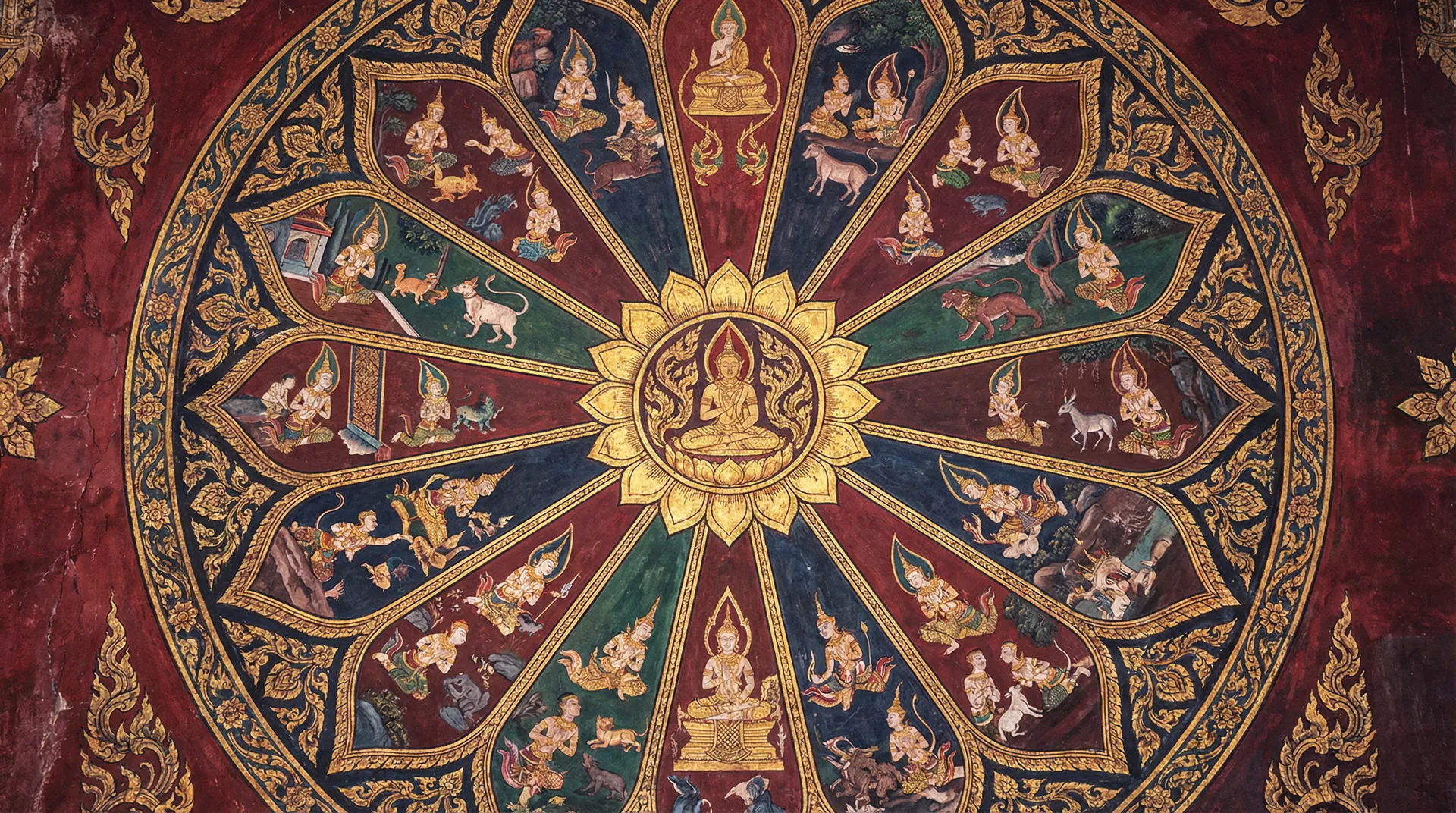
Mugapakkha Jataka
The Tale of the Mute Prince
In the ancient kingdom of Mithila, ruled a wise and benevolent king. His queen, however, harbored a deep secret: she was envious of the king’s affection for his elder son, Prince Bodhisattva, who was destined for the throne. This jealousy festered, and she plotted to undermine him. When the prince was still a child, a wicked sorcerer, bribed by the queen, cast a spell upon him, rendering him mute. The prince, though intelligent and capable, could not speak, and whispers of his 'affliction' began to spread, casting a shadow over his suitability to rule.
As the prince grew, his silence became a source of concern and speculation. The courtiers, influenced by the queen’s machinations, began to doubt his capacity to lead. They spoke in hushed tones, wondering if a king who could not command with his voice was truly fit to govern. The queen, ever watchful, subtly fanned these flames, suggesting that perhaps the younger prince, her own son, was a more viable heir.
One day, a great famine struck the land. The people of Mithila suffered immensely, their fields barren, their granaries empty. The king, though saddened, did his best to provide for his subjects, but the situation grew dire. The queen, seizing this opportunity, approached the king with a cunning proposal. 'My lord,' she said, her voice dripping with feigned concern, 'the people are starving. We need a strong leader, one who can inspire hope and rally the masses. Perhaps it is time to reconsider the succession. The younger prince, though not as favored, can at least speak and rally the people.'
The king, weary and troubled, was swayed by her words. He summoned the elder prince and, with a heavy heart, declared that he would be setting aside the succession in favor of the younger prince. The elder prince, understanding the gravity of the situation and the machinations at play, felt a surge of despair. He knew he could not defend himself with words, nor could he rally the people to his cause in his silent state.
As he sat in his chambers, contemplating this injustice, a wise old hermit, a friend of the royal family, arrived. He had heard of the prince’s plight and the kingdom’s suffering. Seeing the prince’s dejected state, the hermit approached him. 'My prince,' he said, his voice gentle, 'your silence is a heavy burden, but it does not diminish your spirit or your wisdom. The true strength of a leader lies not only in their voice, but in their actions and their understanding of the Dhamma.'
The hermit then revealed a secret: the spell cast upon the prince was not unbreakable. It was tied to a rare herb that grew only on the treacherous slopes of Mount Gandhamadana, a place guarded by fierce beasts and shrouded in perpetual mist. The herb, when brewed into a potion, could break the sorcerer’s enchantment. The hermit offered to guide the prince, for he knew the secret paths and the ways to pacify the creatures of the mountain.
Driven by a newfound hope, the prince agreed. The journey was perilous. They faced roaring lions, venomous serpents, and dizzying precipices. The prince, though mute, displayed immense courage and resourcefulness. He used his keen observation to anticipate dangers, his agility to navigate treacherous terrain, and his strength to overcome physical obstacles. The hermit, impressed by his protégé's bravery, provided guidance and wisdom at each turn.
After weeks of arduous travel, they finally reached the peak where the herb grew. As they carefully gathered the precious plant, a colossal yak emerged from the mist, its eyes blazing with fury. The hermit, drawing upon his spiritual powers, managed to distract the beast momentarily, giving the prince just enough time to gather the herb. They then made their hasty retreat, the yak’s roars echoing behind them.
Upon their return to Mithila, the hermit prepared the potion. As the prince drank it, a wave of warmth spread through him. He opened his mouth, and for the first time in years, words flowed forth, clear and strong. He immediately sought an audience with his father. Addressing the king and the assembled court, he recounted the story of the queen’s treachery and the sorcerer’s spell, his voice ringing with conviction. He then spoke of the famine and proposed a detailed plan to alleviate the suffering, drawing upon his observations and the wisdom he had gained during his journey.
The king, witnessing his son’s eloquent defense and brilliant plan, was filled with remorse for his near-decision. The queen, exposed and shamed, confessed her wicked deeds. The sorcerer was punished, and the queen was banished from the kingdom. Prince Bodhisattva, now able to speak and having proven his wisdom, courage, and resilience, was rightfully declared the next king. He ruled Mithila with justice, compassion, and great wisdom, ensuring prosperity and peace for his people, forever remembering the lessons learned in silence and the arduous journey that restored his voice and his destiny.
— In-Article Ad —
💡Moral of the Story
True strength and leadership are not defined by eloquent speech alone, but by courage, wisdom, and unwavering determination in the face of adversity. Inner qualities shine brighter than outward appearances.
Perfection: Patience, Courage, Wisdom
— Ad Space (728x90) —
More Jataka Tales You May Enjoy
 527Mahānipāta
Mahā-susukajātaka
The Tale of the Contented Monkey In a lush, verdant forest teeming with life, where ancient trees sc...
💡 True happiness and contentment are found not in the abundance of external possessions, but in appreciating what one already has and choosing to find joy in the present moment.
 415Sattakanipāta
Mulaka-Jataka
Mulaka-JatakaIn the vibrant city of Savatthi, where merchants thrived and scholars debated, lived a ...
💡 Integrity and compassion are the most valuable treasures one can possess. True wealth lies in serving others, and perseverance in virtue will ultimately lead to justice and reward.
 474Terasanipāta
Sīlabuya Jātaka
The Tale of the Virtuous PrinceIn the land of Dhāranī lived a king renowned for his righteousness an...
💡 True virtue is demonstrated not by denying wrongdoing, but by a selfless commitment to principles, even when faced with false accusations. Integrity and compassion are the hallmarks of a just ruler.
 490Pakiṇṇakanipāta
Sattigumba Jātaka
Sattigumba JātakaIn the bustling city of Savatthi, renowned for its vibrant markets and the wisdom o...
💡 Cleverness, courage, and strategic thinking can overcome brute force, and compassion coupled with an opportunity for redemption can transform even the most hardened adversaries into contributors to society.
471DvādasanipātaMahājanaka Jātaka
The Tale of King MahājanakaIn the ancient kingdom of Mithilā, a prosperous land graced by gentle bre...
💡 Even in the face of overwhelming adversity, unwavering perseverance and courage can lead to ultimate success. Never give up hope, for even in the darkest of times, a glimmer of light can appear.
 321Catukkanipāta
Nimi Jataka
Nimi JatakaIn the ancient city of Mithila, ruled a just and benevolent king named Nimi. His reign wa...
💡 Even the highest heavens are impermanent, and true, lasting happiness is found not in external pleasures or celestial abodes, but in the cultivation of inner wisdom, compassion, and detachment through the practice of the Dharma.
— Multiplex Ad —